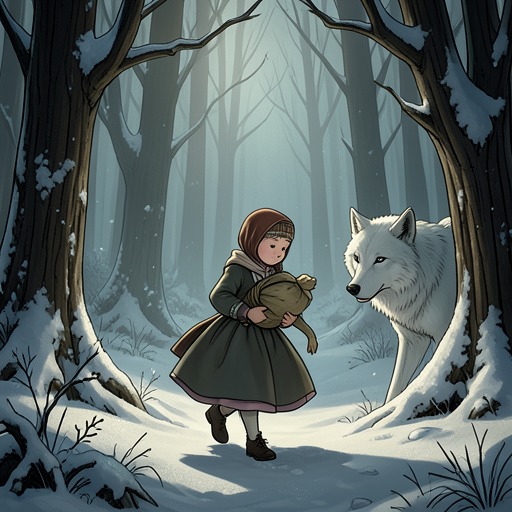
Gerda
The Snow QueenGerda’s defining action is to keep seeking Kay when others conclude that he is lost: her journey turns childhood attachment into a force capable of reaching the Snow Queen’s frozen stronghold. She begins as one of two poor children whose closeness is likened to that of siblings, but her search takes her alone beyond the familiar town. At its decisive moment, she reaches Kay not with a weapon or a gift of supernatural power, but with recognition, an embrace, and tears that melt the ice in his heart and wash away the glass fragment lodged there.
Identity and Early Life
Gerda and Kay are not brother and sister, though they love one another almost as much as if they were. Their families live opposite one another in neighboring garrets, where windows open across the space between the roofs. Wooden boxes set over the water-pipe form a shared garden: herbs grow beside rose-bushes, and the roses’ branches gather around the windows. In summer, the children can cross from one home to the other with a jump; in winter, they must descend the long staircases and go outside through the snow.
That small domestic arrangement establishes the intimacy Gerda later tries to recover. When frost covers the windows, the children warm copper pennies on the stove and press them against the panes to make little round openings through which they can see each other. The image of their faces meeting through separate windows anticipates the distance that later divides them, but also their habit of finding a way to remain connected across it. Gerda’s attachment to Kay is not introduced as a sudden response to danger: it belongs to the ordinary, repeated closeness of their childhood.
The Search Begins
After Kay disappears, Gerda refuses to accept the idea that he is dead. She has heard the claim from the sparrows, and even begins to doubt herself, but chooses to act. Early one morning, while Grandmother is still asleep, Gerda puts on the Red Shoes Kay has never seen and goes alone through the town gates to the river. She offers the shoes in exchange for Kay, giving up something she loves most in the hope that the river can return him.
The river carries the shoes back to the bank. Gerda interprets this as evidence that she did not throw them far enough, climbs into an unfastened boat, and casts them again from farther out. Her movement sends the boat drifting away; the shoes follow behind, always out of reach. Frightened and crying, she can only sit with her stockings on as the sparrows fly beside the shore, singing to comfort her. The accidental separation from land becomes the beginning of her journey. As the boat passes green banks, grazing animals, and finally a cherry orchard with a small red house, Gerda keeps hope alive by imagining that the river may carry her to Kay. She calls to the wooden soldiers outside the house, then sees that they cannot answer.
Trials and the Source of Her Strength
Gerda’s passage through the garden of the Conjuring woman shows how an apparent refuge can also delay her purpose. There, flowers bloom throughout the year, and the narcissus describes a dancing girl absorbed in her own image. Gerda rejects the flower’s account as irrelevant to her search, presses against the rusty latch, and runs barefoot into the wider world. Only after leaving does she realize that summer has ended and autumn is far advanced. The garden’s unchanging season had hidden the passage of time; outside it, yellow willow leaves, falling dew, and dropping leaves make the cost of her delay visible. Her wounded feet and the bleakness around her do not make her abandon the search.
In Finland, the Finland woman refuses to give Gerda additional power. She points instead to what Gerda already possesses: the purity and innocence of her heart, which have helped her get through the world barefoot and have caused people and animals to serve her. The woman says that only Gerda can reach the Snow Queen and remove the glass fragments from Kay. She sends her onward with the Reindeer, who carries her to a bush covered in red berries, two miles from the beginning of the Snow Queen’s garden. Gerda has forgotten her boots and mittens, but the Reindeer cannot stop; after setting her down, he kisses her, weeps, and runs back.
From there, Gerda faces the Snow Queen’s living snowflake guards alone. At the castle, cutting winds rage around her, but when she prays they sink as though falling asleep, allowing her to enter the great hall. Her strength is therefore presented not as an increase in physical power but as persistence, faith, and the capacity to love. The Finland woman’s explanation gives those qualities practical consequence: they carry Gerda where no helper can complete the task for her.
Kay and the Rescue
Gerda arrives just after the Snow Queen has left Kay alone in the enormous hall. She had offered him mastery of himself, the whole world, and a new pair of skates if he could arrange the pieces of ice as required, but he has not succeeded. Gerda recognizes him at once, runs to him, throws her arms around his neck, and holds him fast. Kay remains stiff and cold at first. Then Gerda’s hot tears fall on his breast, penetrate to his heart, thaw the lump of ice, and wash away the fragment of glass that had lodged there.
The rescue reverses the estrangement at the center of their story through the same bodily closeness that marked their early life. In childhood, they looked at one another through holes melted in frozen windowpanes; in the Snow Queen’s hall, Gerda’s tears melt the ice within Kay himself. Her success does not come from receiving a greater force from the Finland woman, but from carrying the strength she already had all the way to him. The scene makes affection an active means of recovery: Gerda’s recognition and embrace reach Kay when he is still unable to respond.
Homecoming and Narrative Significance
After their return journey, Gerda and Kay tell the Robber-girl what has happened. She takes both their hands, promises to visit if she passes through their town, and rides away. Gerda and Kay continue home hand in hand; as they advance, spring grows more beautiful, with green growth and flowers. They recognize their town and its church steeples, hear the bells, and find their way to Grandmother’s door.
The room remains as it was: the old clock still ticks, the roses bloom over the roof and look in at the window, and the little chairs are still there. Yet Gerda and Kay have grown into a woman and a man during their absence. They sit in their childhood chairs and hold hands while the Snow Queen’s cold palace fades from memory like a painful dream. Grandmother reads from the Bible about becoming like little children to enter the kingdom of God, and the two understand the words of the old song. Their return thus joins maturity to recovered childhood rather than erasing either: the children come back grown, but their reunion restores the tenderness and faith associated with their earliest life together.